Bouquet in Mid-Bloom: A Painting Still Negotiating With Itself
A critique of an untitled work-in-progress by Barbara Jerome · acrylic on canvas
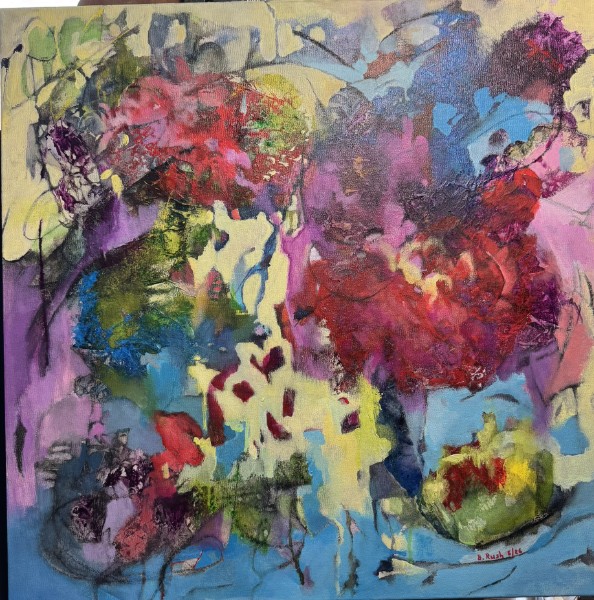
Barbara, untitled (floral), acrylic on canvas, n.d.
The work at a glance
This is an unapologetically painterly floral — somewhere between a Bonnard bouquet, a Joan Mitchell field, and a back-porch bloom seen at peak summer light. Barbara has resisted the easy temptation of botanical literalism. There is no tidy vase, no obedient stem; instead the canvas is given over to clustered color masses that read, almost simultaneously, as peonies, hydrangeas, and the warm static of memory.
The painting succeeds before it has decided what it wants to be — and that is both its charm and its current liability.
What is working
Color, the painting's beating heart
The palette is the strongest decision in the room. Hot crimson and fuchsia are pinned against cool turquoise and cobalt, while the warm beige-yellow ground glows underneath like sun through a screen door. The complementaries don't clash — they vibrate. That is not luck; it is good color instinct.
Composition and movement
The eye is led in a loose counter-clockwise spiral: the magenta mass at upper right, the deep red-violet cluster mid-right, the green-yellow blossoms tumbling down, the dark anchor at lower left, then back up the cool blue passage on the left edge. The pale yellow corridor through the middle functions as a breath of negative space and is, quietly, the painting's most sophisticated move.
Surface variety
Thin scumbles sit next to opaque, buttery patches; soft dissolved edges live next to crisp gestural marks. The surface invites the viewer in close. Acrylic too often dries into a uniform plastic skin — Barbara has avoided that.
Where the painting is still negotiating
The lower-left quadrant is doing too much and saying too little
The darkest passages collapse into a muddled zone where leaves, shadow, and possible vase all compete without a clear winner. Right now it functions as ballast, but ballast without form. This is the area most likely to keep the painting from resolving.
Center clarity
Several forms in the central cluster trail off into transitional patches that read as "I'll come back to this." A few don't yet earn their place. The viewer's eye keeps trying to land and being asked to keep moving.
The upper edge and outer margins
These feel comparatively raw. Not necessarily wrong — Joan Mitchell often left the perimeter open — but here the rawness reads more like unfinished than chosen.
Value range
Saturation is doing the work that value should also be doing. There is plenty of bright and a fair amount of dark, but the mid-values are crowded. Squinted at, the painting flattens.
The painting's problem is not that it is too loose. It is that it has not yet decided which of its looseness was discovery and which was indecision.
Recommendations to finish
Offered in the spirit of the work Barbara already has, not a different painting:
- Resolve the lower-left anchor. Decide whether that dark mass is foliage, a vase, or pure abstract weight — then commit. Even a single dark, confident curved edge would give the eye something to rest on.
- Reclaim two or three "hero" blossoms. Pick the upper-right magenta cluster and one other and give them slightly firmer petal edges or a single accented dark contour. Leave the rest as suggestion. Contrast between resolved and unresolved is the engine of painterly abstraction.
- Protect the yellow corridor. Do not paint over the pale central opening. It is structurally load-bearing. If anything, gently reinforce it with a thin warm glaze.
- Open the value range. Add a few near-white highlights — not chalky, but a warm cream — on two or three petal edges facing the implied light source (upper left feels natural). Then push one or two darks slightly deeper near the lower-left anchor. The painting will gain depth without losing color.
- Quiet the busiest mid-value passages. A thin transparent wash of the background warm beige over the most crowded central patches will knock them back and let the hero blooms come forward.
- Address the edges with intention. Either carry color cleanly to all four edges, or deliberately let the canvas breathe at the margins. Right now the top edge is doing neither.
- Sign it, and stop. One of the real risks here is overworking. The painting is closer to done than it probably feels to Barbara. After the moves above, walk away for 48 hours before any more decisions.
The verdict
This is a generous, alive painting by someone with a real eye for color and a willingness to take expressive risks. It is not yet finished, but it is finished-able — and that is a more interesting place to be than a polished painting with nothing to say. With a small, disciplined pass focused on anchoring the lower left, picking two or three blossoms to bring forward, and widening the value range, this work will hold a wall with confidence.